
Many organisations launch mentoring programmes with strong intentions. They want to strengthen leadership, support talent development, increase inclusion or break down silos across the organisation. Ambition is there, and often so is the initial energy. Mentors and mentees are matched, a framework is introduced, and meaningful conversations begin to take place.
However, after a period of time, the momentum slows down. Participation becomes uneven. The programme continues to exist, but it no longer drives real organisational change. What once felt like a strategic investment gradually turns into a well-meaning HR initiative.
This is where the distinction becomes crucial: a mentoring programme creates activity, but a mentoring culture creates capability.
When mentoring remains an initiative
There is nothing wrong with starting with a programme. In fact, it is often the necessary first step. Structure, clarity of roles and defined objectives are essential for quality and credibility. However, a mentoring programme does not automatically influence how leaders lead, knowledge is shared or development is prioritized.
If mentoring is not anchored in leadership commitment, strategic priorities and everyday behaviour, it risks remaining an isolated effort. It becomes something people participate in for a period of time rather than something that shapes how the organisation learns and evolves.
Sustainable impact requires mentoring to move from being an event to becoming infrastructure.
What it truly means to build a mentoring culture
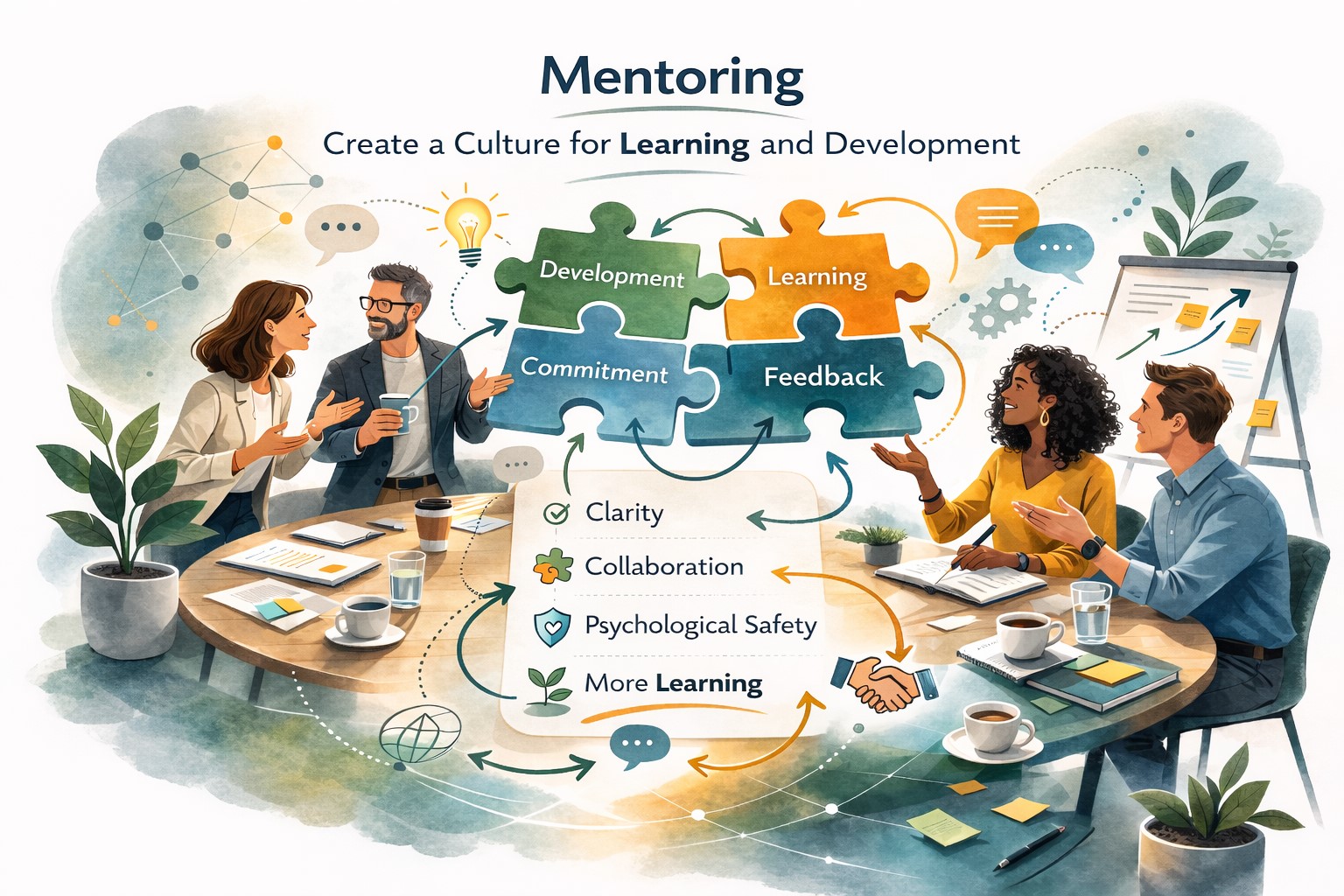
Building a mentoring culture means embedding mentoring into the way the organisation thinks about development, leadership and collaboration. It is about integrating mentoring into leadership pipelines, talent strategies and succession planning, rather than positioning it as a stand-alone initiative.
In a mentoring culture, curiosity, reflection and knowledge sharing are visible in the way leaders think, act and engage with others. Dialogue across hierarchies becomes natural. Psychological safety supports honest conversations about challenges and growth. Mentoring is not limited to formal matches; it influences how feedback is given, how experience is transferred and how potential is developed.
Importantly, mentoring is also connected to measurable outcomes and strategic goals. It supports the organisation’s direction rather than running parallel to it. When this alignment is present, mentoring becomes a driver of performance, engagement and inclusion.
The journey from programme to culture
Organisations rarely move directly from zero to a fully embedded mentoring culture. It is a maturity journey.
The first step is often moving from informal, ad hoc mentoring relationships to structured programmes with clear purpose, defined expectations and trained mentors. This stage builds credibility and ensures quality.
The next step is strategic integration. Here, mentoring becomes aligned with business priorities and leadership development agendas. Governance structures are clarified, leaders are actively involved, and outcomes are tracked and evaluated.
The final stage is when mentoring becomes part of the organisational DNA. At this point, mentoring influences how leaders think about development, how talent is nurtured and how collaboration happens across the organisation. It is no longer dependent on a single programme cycle; it is embedded in the culture.
The organisational impact of a mentoring culture
When mentoring becomes part of the culture, the impact extends far beyond individual mentoring pairs. Leaders become more reflective and intentional in their development of others. Cross-functional collaboration increases because relationships and understanding are strengthened across boundaries. Inclusion becomes more than a policy statement, as diverse perspectives are actively engaged in developmental conversations.
Organisations with strong mentoring cultures often experience higher engagement and retention because employees feel seen, supported and invested in. At the same time, they become more agile and learning oriented. Knowledge flows more freely, and the organisation is better equipped to adapt to change.
In a rapidly evolving business landscape, this collective learning capability becomes a significant competitive advantage.
A long-term investment in capability
Building a mentoring culture is not a quick fix. It requires strategic clarity, leadership commitment and a willingness to work systematically with design, implementation and anchoring. It also requires patience, as cultural shifts happen over time through consistent behaviour and reinforcement.
However, the return on this investment is substantial. A mentoring culture strengthens leadership pipelines, supports inclusion, accelerates talent development and builds resilience across the organisation.
The real question for organisations is therefore not whether mentoring works. The evidence is clear that it does. The question is whether mentoring is treated as a temporary initiative or developed as a long-term strategic capability.
Because mentoring, when embedded in culture, does more than support individual growth. It shapes how the organisation learns, leads and succeeds.
